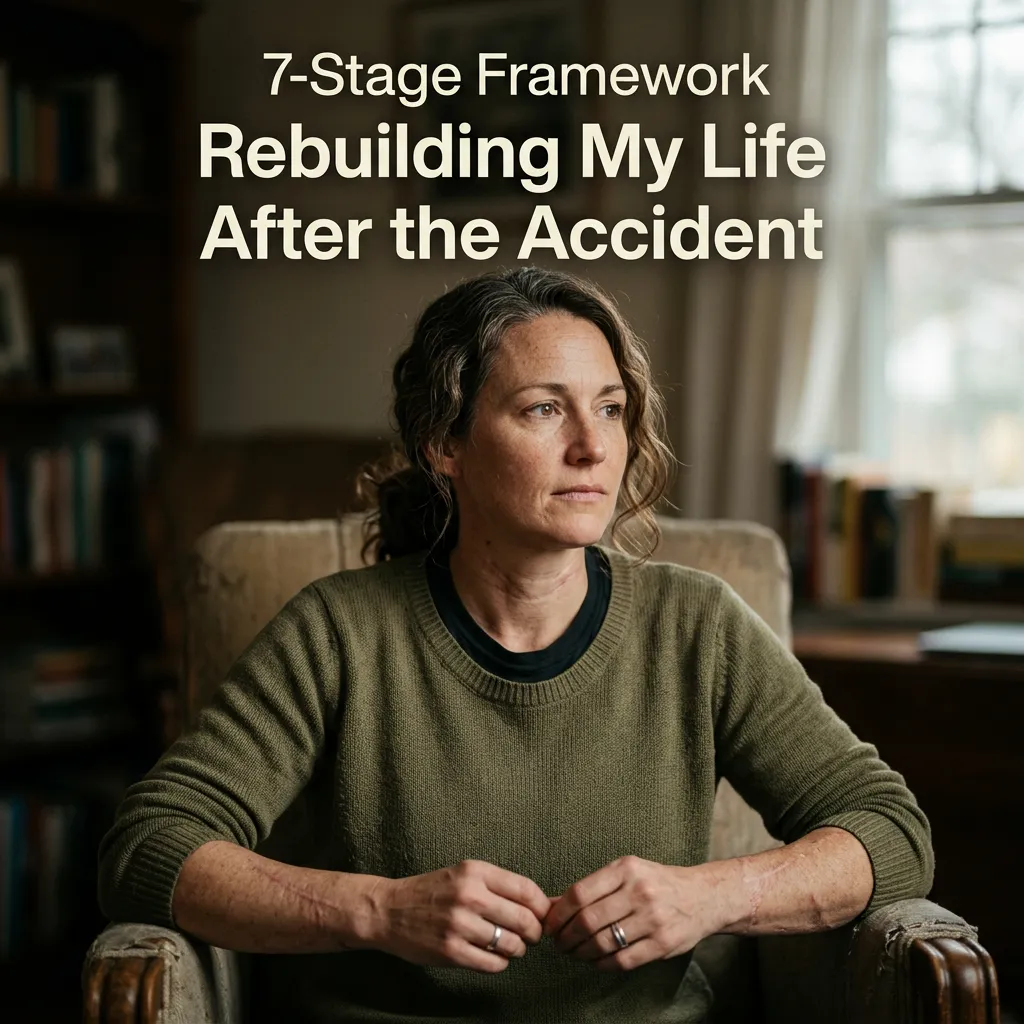
The 7-Stage Framework I Used to Rebuild My Life After the Accident
“If you can stand, you can move. If you can move, you can live..”
- Simon Clark

There are moments where life hits you so hard reality splits open.
One breath, the world is ordinary.
The next, everything is different — broken in ways you are not prepared for and did not consent to.
The night of the accident, my life didn’t just crack.
It shattered.
Bone, memory, breath — all of it violently rearranged.
And the days that followed were worse.
Not because of the pain — though that was considerable — but because everything I believed myself to be evaporated in front of me. Identity, purpose, direction, future… they all dissolved like fog under hospital lights.
It took me years to rebuild.
Not return — rebuild.
There is a difference.
Returning implies restoration.
Rebuilding implies creation.
This is my mental resilience framework, the one I used to pull myself out of paralysis, depression, devastation, and the deepest grief I’ve ever known. It is the path I followed — imperfectly, painfully, necessarily — and the path I offer now to anyone who is starting over after loss.
These aren’t ideas.
They are scars shaped into steps.
Here are the 7 stages of how to rebuild a life when the world has taken everything from you.
1. IMPACT — The Moment Life Breaks
Every story of rebuilding begins with rupture.
Impact is the moment the world punches through your body and rearranges your reality. It’s the phone call you never wanted. The diagnosis. The breakup. The betrayal. The accident that steals your breath.
Impact is violent.
Immediate.
World-ending.
This stage is not about strength — it’s about survival.
In the hospital, machines breathed for me. My neck was broken. My partner was gone. I couldn’t move my fingers, let alone my legs. I was trapped in a body that felt more like a cage than a home.
Nothing in the world prepares you for the moment where life stops being a continuation of what was, and starts being something unfamiliar and terrifying.
Impact is the death of the old story.
Every trauma recovery step begins here — not with acceptance, not with courage, not with inspiration — but with devastation.
2. COLLAPSE — When Identity, Purpose, and Agency Fall Away
Collapse is the stage most people refuse to talk about.
It’s the part where you lose everything internally — not physically, but psychologically.
Your sense of self fractures.
Your plans evaporate.
Your capacity for belief disintegrates.
This stage is necessary.
After the accident, I didn’t know who I was anymore.
I wasn’t strong.
I wasn’t independent.
I wasn’t capable.
I felt emptied out, like someone had wiped the slate of my identity clean.
And that’s the truth people fear:
Collapse is not failure.
Collapse is truth.
Because collapse reveals that who you thought you were was never the full story.
If you’re starting over after loss, collapse is not your enemy.
It is the soil in which your next self is planted.
3. STILLNESS — The Dead Space Before Rebuilding
Stillness is the aftermath.
It’s the moment after collapse where nothing moves — inside or outside you.
It feels like being suspended in grief, frozen between the life you had and the life you aren’t ready to begin.
This stage feels like nothing is happening, but in reality, something crucial is:
Your nervous system is recalibrating.
Your mind is digesting the impact.
Your heart is learning to beat in a world you didn’t choose.
Stillness is the incubation stage of emotional healing — quiet, heavy, necessary.
People try to rush this stage.
They want action.
Progress.
A sign they’re “getting better.”
But stillness is part of how to rebuild life.
Healing happens before motion.
Regrowth happens before movement.
Identity roots itself in silence first.
4. ANCHOR — Finding One Reason to Move
Movement doesn’t return suddenly.
It returns in sparks.
An anchor is anything — a memory, a promise, a person, a dream — that gives you the smallest reason to take your next breath on purpose.
In the hospital, my anchor was Olivia.
She sat beside my bed, held my hand through the shaking, and told me — gently, insistently — that I wasn’t done yet.
She didn’t know if that was true.
Neither did I.
But belief is not always required.
Sometimes you move for someone else’s belief until you grow into your own.
Anchors look different for everyone:
• A child
• A friend
• A future self
• A mountain you promised to climb
• The faint whisper that says “not yet”
Anchors don’t pull you out.
They pull you forward.
This is one of the most crucial trauma recovery steps:
Find one reason to move — not forever, just once.
The next reason will appear after.
5. ACTION — The Smallest Possible Step
Action is where rebuilding truly begins.
Not big action.
Not heroic action.
Not inspirational action.
The smallest possible step.
For me, it was learning to sit upright.
Then learning to stand.
Then learning to take a single step without collapsing.
Those steps weren’t impressive.
But they were mine.
And with every step, something subtle happened:
self-respect returned.
Your brain rewrites its story through action.
Not through thought.
Not through intention.
Through movement.
This is the part of my journey that people misunderstand.
They think action is about progress.
It’s not.
It’s about identity.
Each tiny action is a message:
“I am someone who tries.
I am someone who moves.
I am someone who refuses to disappear.”
This is why action is central to any mental resilience framework — because action rebuilds belief, molecule by molecule.
6. EXPANSION — Choosing an Impossible Goal
Real healing doesn’t happen through comfort.
It happens through expansion.
And expansion requires goals that terrify the old version of you.
For me, it was PenyFan.
When the physio team asked me to set “realistic” goals, I did the opposite. I chose the impossible — a mountain that represented everything I was told I could never be again.
That decision rewired my entire life.
Impossible goals force you to expand.
They demand discipline.
They demand sacrifice.
They demand a confrontation with the identity you’re leaving behind.
Once you choose an impossible goal:
• your effort reorganizes
• your values clarify
• your identity evolves
• your strength compounds
• your story changes
This is when the world stops happening to you and starts happening from you.
Expansion is the stage where you transition from survival to creation.
It is essential to how to rebuild life, because rebuilding without expansion is just recovery — not rebirth.
7. REBIRTH — Becoming the New Iteration of Yourself
Rebirth is not a return.
It’s an arrival.
An arrival into the version of you that pain revealed, effort shaped, and courage carried.
This stage happened for me across several moments:
When I took my first unassisted steps.
When I reached PenyFan’s summit.
When I crossed Iceland after being unable to walk days before.
When I fulfilled my promise and stood at Everest Base Camp.
Each of those moments was a declaration:
“I am no longer who I was.
I am the person I fought for.”
Rebirth does not erase the trauma.
It integrates it.
It transforms suffering into meaning.
Pain into narrative.
Identity into choice.
Rebirth is the final stage of starting over after loss — not because the journey ends here, but because you finally stand on ground you chose.
A new story begins.
A new self emerges.
And that self is forged — not found.
This 7-Stage Framework Is Not Theory.
It Is Survival, Structured.**
Most frameworks avoid the messy parts.
This one begins with them.
Most healing models skip collapse and stillness.
This one honours them.
Most self-help promises shortcuts.
This one promises honesty.
Because rebuild is not a slogan.
Rebuild is a discipline.
And the moment you commit to these seven stages, your life begins to shift — not instantly, not dramatically, but undeniably.
This is how to rebuild life when the world has taken everything from you:
Impact → Collapse → Stillness → Anchor → Action → Expansion → Rebirth
A sequence.
A cycle.
A path you can walk.
Even now.
Especially now.
Because your story is not over.
You are simply between chapters.
The 60-Second Storm Test
When you finish reading this, set a timer for 60 seconds.
During that minute, pick one tiny action you’ve been avoiding — and do it immediately.
Here are examples:
• Put one dish away
• Send one message you’ve been delaying
• Drink a glass of water
• Open the document you’re scared to start
• Pick up one item off the floor
• Write one sentence
• Do one push-up
• Throw away one thing you don’t need
Why 60 seconds works:
Because momentum > motivation.
Because movement breaks paralysis.
Because your brain needs proof that you can still move.
When the timer ends, ask yourself:
Did that feel impossible — or did it feel like a beginning?
That’s the rule in action:
Not heroic motion.
Not perfect motion.
Just motion.
