The Science of Grit: What Mountains Teach Us That Psychology Doesn’t
“If you can stand, you can move. If you can move, you can live..” - Simon Clark
Grit is a word people like to romanticize.
Psychologists define it as passion and persistence toward long-term goals.
A tidy formula. A clean equation.
And in academic circles, that definition has become gospel, the foundation of much of today’s resilience research.
But anyone who has ever stood on the edge of collapse knows something the textbooks don’t:
Passion is the first thing to die when life gets hard.
And persistence looks nothing like what you imagined when the world caves in.
If grit were truly just passion + persistence, then the strongest people I’ve met should have never broken.
And yet they did.
What saved me — and what saves the people who walk out of hell with their soul intact — isn’t passion.
It isn’t motivation.
It isn’t a vision board or a five-year plan.
It’s something far older, far wilder, far less comfortable:
the willingness to become someone new under pressure.
In this piece, I want to talk about what grit really means, not as theory, but as something lived. Something I learned the hard way through mountains, trauma, and the kind of moments that don’t leave you the same.
Because the mountains don’t care about your passion.
Storms don’t care about your goals.
And earthquakes don’t wait for you to be ready.
The science of grit explains the idea.
The mountains taught me the truth.

1. What Psychology Says Grit Is, and Why It Falls Apart in Real Life
In academic terms, grit is defined by two qualities:
Consistency of interests
Perseverance of effort
Useful on paper.
Dangerously incomplete in reality.
When my life fell apart after the accident, I had no consistency of interests.
I didn’t even have a “self” to return to.
The future was a blank void. Passion was nowhere to be found.
So how do you persist when persistence has no object?
That’s where the theories crack.
Much of psychology measures grit in controlled environments: classrooms, structured programs, stable conditions.
But the moments when grit actually saves lives don’t happen in controlled environments. They happen in chaos, the kind of chaos no researcher can ethically recreate.
Which means the scientific model is missing the most important variable:
What happens when you have no passion, no plan, no strength left — only fear, pain, and the decision to keep moving anyway?
That is where grit begins.
And that is where the mountains took over my education.
2. Grit Is Surviving When Passion Dies
After the accident, I was told I’d never walk again.
Passion?
Gone.
Purpose?
Nonexistent.
Identity?
Shattered.
The physio team asked me to set realistic goals. They suggested small, sensible steps, like walking small distances, sitting upright, learning to balance again.
Instead, I blurted out:
“By the end of summer, I’m going to climb Pen y Fan.”
They sent me for a psychological assessment.
But here’s the truth: climbing that mountain had nothing to do with passion.
It wasn’t a dream.
It wasn’t inspiring.
It wasn’t even something I wanted.
It was a test, the first of many life lessons that taught me what grit feels like from the inside.
Passion is optional.
Movement is not.
That climb took three times longer than it should have. Every step was an argument between my mind and my pain. But I learned something that no scientific paper had ever taught me:
Grit is what remains when passion has died and you move anyway.
That is the part of grit that research struggles to quantify.
But mountains measure it with perfect accuracy.
3. Grit Is Choosing Pain Without a Witness
One of the greatest myths of resilience is that grit comes from external validation: support, encouragement, accountability.
But the science of grit rarely accounts for what happens in the dark, when no one is watching, when the world is asleep and you are alone with your fear.
Namche Bazaar.
One of the highest towns on Earth.
A woman I had shared tea with days before collapsed in her room. Blood poured from her mouth as altitude sickness crushed her lungs. People screamed for help.
I ran barefoot into the cold and helped lift her onto a stretcher.
My doctors had told me never to lift heavy things again.
Never to strain my chest.
Never to push that hard.
Grit doesn’t care about never.
Grit cares about now.
Running through the freezing night, my heart tore itself into chaos. I collapsed in the street. Everyone disappeared into the darkness. I was alone, freezing, dizzy, half-conscious, and lost.
There were no cameras.
No encouragement.
No applause.
No accountability partner.
Just a dark street and a choice.
My survival depended on the quietest, loneliest kind of grit, the kind psychology cannot measure:
Choosing pain without an audience.
Choosing effort without reward.
Choosing forward without witnesses.
Persistence is easy when people are watching.
Real grit is what you do when they aren’t.
4. Grit Is Walking Into Fear, Not Away From It
When the earthquake hit Marrakech, I didn’t feel brave.
I felt fear sharpen my senses until the world became a knife-edge.
I heard screaming.
I saw buildings crack open like eggshells.
I felt dust choking the night air.
And still, I ran toward the rubble.
Not because I knew what to do.
Not because I felt capable.
Not because I had some heroic instinct.
I ran because people were buried.
And fear isn’t a stop sign unless you let it be.
Psychology often frames grit as managing fear.
Mountains taught me a different lesson:
Fear doesn't need to be managed.
It needs to be walked into.
That night changed me.
It dismantled whatever fragile beliefs I still held about who I was or wasn’t allowed to be.
One of the deepest life lessons from extreme challenges is that fear is rarely the enemy.
Avoidance is.
Grit is not the absence of fear.
It is the decision that fear does not get to steer.
5. Grit Is Deciding Who You’ll Be Under Stress
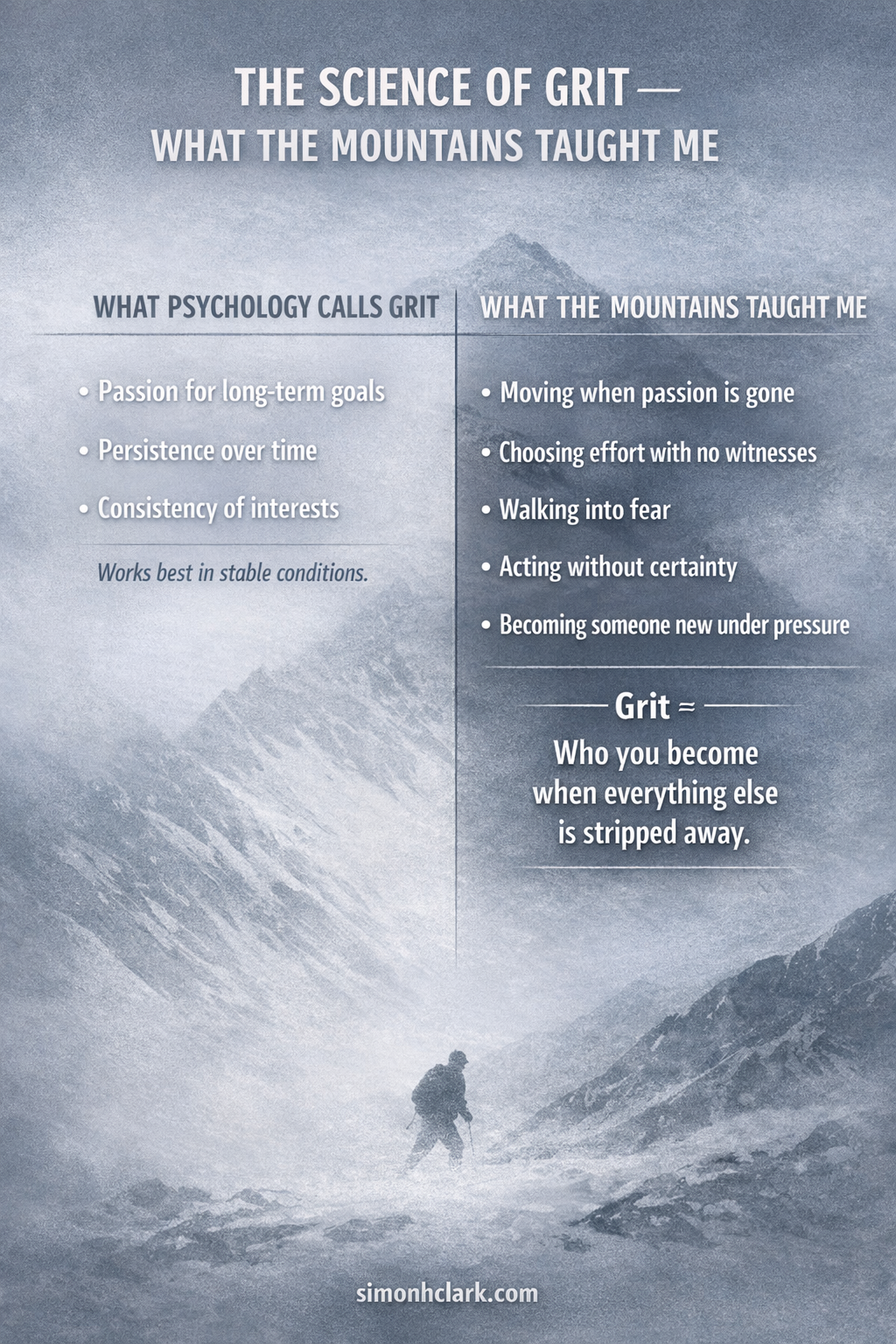
Much of resilience research highlights traits like conscientiousness, self-control, and long-term goals.
But mountains and disasters reveal something deeper:
When stress strips away everything — identity, strength, confidence, clarity — you are left with a single question:
Who am I in this moment?
Not who you were yesterday.
Not who you hope to be tomorrow.
Not what your personality test says.
When the world collapses, you choose, consciously or unconsciously, the version of yourself that will act.
And that choice becomes your grit.
During the Iceland storm, during the Everest collapse, during the Morocco rescue, I didn’t act as the “best” version of myself.
I acted as the version that refused to stop.
Psychology tells us grit is a trait.
Mountains teach us grit is an identity you choose in real time.
6. What Grit Really Means
After everything I’ve lived through, here is what grit really means, distilled into its rawest form:
Grit is the willingness to suffer today for a version of yourself you haven’t met yet.
It is not passion.
Passion fades.
It is not motivation.
Motivation evaporates.
It is not discipline.
Discipline cracks under extreme stress.
Grit is a relationship with pain.
A willingness to do hard things without knowing if they’ll pay off.
A willingness to move when everything in you wants to freeze.
A willingness to grow when growth hurts.
The science measures outcomes.
The mountains measure refusal.
7. The Bridge Between Research and Reality
I am grateful for the psychological frameworks.
They give language to things that feel indescribable.
But grit is not built in laboratories.
It is built:
on mountainsides
in hospital beds
in collapsed cities
in quiet rooms where people decide to keep living
in moments that never make it into the data set
The science of grit explains the skeleton.
Life provides the flesh.
And mountains, literal or metaphorical, supply the scars.
8. Bringing Mountain Grit Into Everyday Life
You don’t need to climb Everest or survive earthquakes to understand grit.
You only need to practice the mountain version of it:
When passion dies, move anyway.
When no one is watching, choose effort.
When you’re terrified, walk toward it.
When the world breaks, choose who you will be.
This is what the highlands taught me.
This is what the earthquake taught me.
This is what my own shattered body taught me.
And it is a lesson anyone can learn.
Because grit is not reserved for the chosen.
It is available to anyone willing to become larger than their pain.
It is the quiet, stubborn, unglamorous part of the soul that refuses to give up.
Psychology describes it.
The mountains demand it.
And somewhere between theory and survival lies the truth:
Grit is who you become when everything else is stripped away.
The Pressure Identity Test
A short, confronting exercise to reveal who you actually become under stress, not who you think you are.
Read this once. Then answer honestly.
Psychology often asks:
Who do you want to be?
Mountains ask a different question:
Who do you become when everything is stripped away?
This exercise is about answering that question without romance.
STEP 1: Recall a Pressure Moment
Think of a moment when:
You were exhausted, scared, overwhelmed, or in pain
There was no audience
There was no reward
There was no clear “right” choice
Write the moment in one sentence only:
“The moment I’m thinking of is…”
STEP 2: The Identity That Appeared
In that moment, you became someone, whether you chose it consciously or not.
Circle the closest description (or write your own):
The one who avoided
The one who endured quietly
The one who moved despite fear
The one who froze
The one who carried more than expected
The one who protected others
The one who shut down
The one who refused to stop
“Under pressure, I became…”
No judgment. Just truth.
STEP 3: The Cost
Every identity under stress has a cost.
What did it cost you to be that person in that moment?
Physically
Emotionally
Relationally
“Being that version of myself cost me…”
STEP 4: The Choice Point
Now the mountain question:
If I face pressure like that again, is this still who I want to be?
Answer one of the following and finish the sentence:
Yes, because…
No, because…
I don’t know yet, but…
STEP 5: The Mountain Definition of Grit
Complete this sentence without trying to sound strong:
“Grit, for me, means being the person who…”
That sentence, not a test score, not a personality trait, is your real grit.
